 Class Notes NCERT Solutions for CBSE Students
| School Name: | St. Margaret Sr. Sec. School, Prashant Vihar, Rohini, New Delhi 110085 India |
| Class: | XII |
| Subject: | Physics |
| Exam: | Mid Term Examination (2026–2027) – Set A |
| Time: | 3 Hour |
| Maximum Marks: | 70 |
| Date: | September, 2026 |
General Instructions:
- There are 33 questions in all. All questions are compulsory.
- This question paper has five sections: Section A, Section B, Section C, Section D and Section E.
- All the sections are compulsory.
- Section A contains sixteen questions, twelve MCQ and four Assertion-Reasoning based of 1 mark each, Section B contains five questions of two marks each, Section C contains seven questions of three marks each, Section D contains two case study based questions of four marks each and Section E contains three long answer questions of five marks each.
- Use of calculators is not allowed.
- You may use the following values of physical constants wherever necessary
c = 3 x 10⁸ m/s
me = 9.1 x 10⁻³¹ kg
e = 1.6 x 10⁻¹⁹ C
μ0 = 4 pi x 10-7 TmA-1
h = 6.63 x 10⁻³⁴ Js
ε0 = 8.854 x 10⁻¹² C2 N-1 m-2
Avogadro’s number = 6.023 x 10²³ per gram mole
SECTION – A
Question 01: A diamagnetic substance is brought near the north or south pole of a bar magnet. It will be
- Repelled by both the poles
- attracted by both poles
- repelled by the north pole and attracted by the south pole
- attracted by the north pole and repelled by the south pole
Question 02: Which of the following pairs is that of paramagnetic material?
- Copper and Aluminium
- Sodium and Calcium
- Lead and Iron
- Nickel and Cobalt
Question 03: A battery supplies 0.9 A current through a 2 ohm resistor and 0.3 A current through a 7 ohm resistor when connected one by one. The internal resistance of the battery is
- 2 ohm
- 1.2 ohm
- 1 ohm
- 0.5 ohm
Question 04: A point charge situated at a distance ‘r’ from a short electric dipole on its axis, experiences a force F. If the distance of the charge is ‘2r’, the force on the charge will be
- F/16
- F/8
- F/4
- F/2
Question 05: An electric dipole of length 2 cm is placed at an angle of 30 degrees with an electric field 2 x 10^5 N/C. If the dipole experiences a torque of 8 x 10^-3 N m, the magnitude of either charge of the dipole is
- 4 microC
- 7 microC
- 8 mC
- 2 mC
Question 06: The electrostatic potential on the surface of a charged conducting sphere is 100 V. Two statements are made in this regard:
S1: At any point inside the sphere, electric intensity is zero.
S2: At any point inside the sphere, the electrostatic potential is 100 V.
Which of the following is a correct statement?
- S1 is true and S2 is false
- Both S1 and S2 are false
- S1 is true, S2 is also true and S1 is the cause of S2
- S1 is true, S2 is also true but the statements are independent.
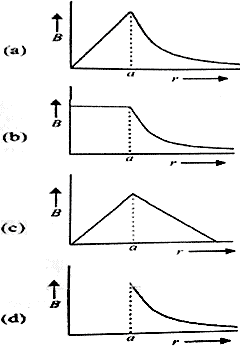
Question 07: The magnetic field B due to a straight conductor of uniform cross-section of radius ‘a’ and carrying a steady current varies with the distance ‘r’ from the centre of conductor as shown in graph.
- (a)
- (b)
- (c)
- (d)
Question 08: The magnetic flux through a coil perpendicular to the plane is varying according to the relation phi = 5t^2 + 4t + t. The induced emf in the coil at t = 2 sec.
- 22 V
- 24 V
- 25 V
- 27 V
Question 09: The phase difference between the current and the voltage in series LCR circuit at resonance is
- pi
- pi/2
- pi/3
- Zero
Question 10: If rms current in a 50 Hz AC circuit is 5 A, the value of the current 1/300 seconds after its value becomes zero is
- 5 sqrt(2) A
- 5 sqrt(3/2) A
- 5/6 A
- 5/sqrt(2) A
Question 11: The reactance of a capacitance at 50 Hz is 5 ohm. If the frequency is increased to 100 Hz, the new reactance is
- 5 ohm
- 10 ohm
- 2.5 ohm
- 125 ohm
Question 12: Which of the following is not the property of an equipotential surface?
- They do not cross each other.
- The work done in carrying a charge from one point to another on an equipotential surface is zero.
- For a uniform electric field, they are concentric spheres.
- They can be imaginary spheres.
For Questions 13 to 16, two statements are given – one labelled Assertion (A) and other labelled Reason (R). Select the correct answer to these questions from options as given below.
(a) If both Assertion and Reason are true and Reason is correct explanation of Assertion.
(b) If both Assertion and Reason are true but Reason is not the correct explanation of Assertion.
(c) If Assertion is true but Reason is false.
(d) If both Assertion and Reason are false/Assertion is false and Reason is True.
Question 13:
Assertion: When radius of a current carrying loop is doubled, its magnetic moment becomes four times.
Reason: The magnetic moment of current carrying loop is directly proportional to the area of the loop.
Question 14:
Assertion: Electric field is always normal to equipotential surfaces and along decreasing order of potential.
Reason: Negative gradient of electric potential is electric field.
Question 15:
Assertion: Diamagnetic substances exhibit magnetism.
Reason: Diamagnetic materials do not have permanent magnetic dipole moment.
Question 16:
Assertion: The energy of a charged particle moving in a magnetic field does not change.
Reason: Radius of circular motion of charged particle in uniform magnetic field depends on its linear momentum.
SECTION – B
Question 17:
Write four important properties of the magnetic field lines due to a bar magnet.
Question 18:
(a) Plot a graph showing the variation of resistivity ‘rho’ versus temperature ‘T’ for Semiconductor.
(b) Define the term ‘Mobility’ of electrons. Write its SI unit.
OR
A heating element using nichrome is connected to a 220 V supply. Initially it draws a current of 2.9 A. After some time, the current attains a steady value of 2.5 A. Find the temperature of the heating element if the room temperature is 27 degrees C. The temperature coefficient of resistance of nichrome is 1.7 x 10^-4 per degree C.
Question 19:
Two long straight parallel wires separated by 20 cm, carry 5 A and 10 A current respectively, in the same direction. Find the magnitude and direction of the net magnetic field at a point midway between them.
OR
An electron moving with a velocity v = (1 x 10^7 i-hat + 0.5 x 10^7 j-hat) m/s enters a region of uniform magnetic field B = (0.5 j-hat) mT. Find the radius of the circular path described by it.
Question 20:
A plane surface, in shape of a square of side 1 cm is placed in an electric field E = (100 N/C) i-hat such that the unit vector normal to the surface is given by n-hat = 0.8 i-hat + 0.6 k-hat. Find the electric flux through the surface.
Question 21:
What is motional emf? Derive an expression of motional emf across the ends of a conductor moving in perpendicular magnetic field.
OR
A metallic rod of length L is rotated at an angular speed omega normal to a uniform magnetic field B. Derive expressions for the (i) emf induced in the rod and (ii) current induced, if the resistance of the rod is R.
SECTION – C
Question 22:
(a) State Lorentz force.
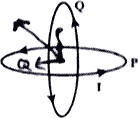
(b) Two identical circular wires P and Q each of radius R and carrying current I and √3 I are kept in perpendicular planes respectively such that they have a common centre as shown in the figure. Find the magnitude and direction of magnetic field at the common centre of the two coils.
Question 23:
A uniform magnetic field gets modified as shown in figure when gets modified as shown in figure when two specimens A and B are placed in it.
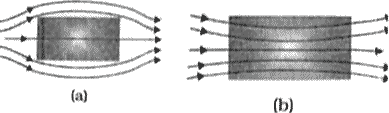
(i) Identify the specimen A(a) and B(b).
(ii) How is the magnetic susceptibility of specimen A different from that of specimen B?
(iii) What will be the effect of temperature on the magnetic susceptibility of A and B?
Question 24:
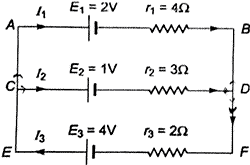
State Kirchhoff’s rules. Use these rules to write the expressions for the currents I1, I2 and I3 in the Circuit diagram shown.
Question 25:
(a) What is Wattless current?
(b) An electric lamp connected in series with a capacitor and ac source is glowing with a certain brightness. How does the brightness of the lamp change on reducing the (i) capacitance and (ii) frequency?
Question 26:
(a) State Lenz’s law.
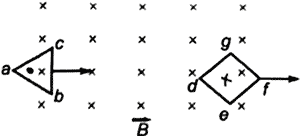
(b) Two loops of different shapes are moved in a region of uniform magnetic field in the directions marked by arrows as shown in the figure. What is the direction of the induced current in each loop?
Question 27:
Define electric dipole moment. Is scalar or vector quantity? Derive the expression for the electric field of a dipole at a point on the axial line of dipole.
OR
Define electric potential. Write a relation between electric field and electric potential. Derive an expression for the electric field of dipole at a point on the equatorial line of a dipole.
Question 28:
A particle having a charge +5 microC is initially at rest at the point x = 30 cm on the x-axis. The particle begins to move due to the presence of a charge Q that is kept fixed at the origin. Find the kinetic energy of the particle at the instant it has moved 15 cm from its initial position if Q = +15 microC.
SECTION – D
Question 29:
Dielectrics play an important role in design of capacitors. The molecules of a dielectric may be polar or non-polar. When a dielectric slab is placed in an external electric field, opposite charges appear on the two surfaces of the slab perpendicular to electric field. Due to this an electric field is established inside the dielectric. The capacitance of a capacitor is determined by the dielectric constant of the material that fills the space between the plates. Consequently, the energy storage between the plates is affected.
(i) Which of the following is a polar molecule?
(A) O2
(B) H2
(C) N2
(D) HCl
(ii) Which of the following statements about dielectrics is correct?
(A) A polar dielectrics has a net dipole moment in absence of an external electric field which gets modified due to the induced dipoles.
(B) The net dipole moments of induced dipoles is along the direction of the applied electric field.
(C) Dielectrics contain free charges.
(D) The electric field produced due to induced surface charges inside a dielectric along the external electric field.
(iii) When a dielectric slab is inserted between the plates of an isolated charged capacitor
(A) Increases and the electric field inside it also increases
(B) Decreases and the electric field also decreases
(C) Decreases and the electric field increases
(D) Increases and the electric field decreases
(iv) Two capacitors of capacitances 2C0 and 6C0 are first connected in series and then in parallel across the same battery. The ratio of energies stored in series combination to that in parallel is
(A) 1/4
(B) 1/6
(C) 2/15
(D) 3/16
Question 30:
Moving Coil Galvanometer: A moving coil galvanometer is a sensitive device which can be used to check if a current is flowing in a circuit. A galvanometer works on the principle that a current carrying coil placed in a radial magnetic field experiences a deflecting torque whose magnitude is directly proportional to the electric current passing through it. Galvanometer can be converted into a voltmeter and ammeter.
(i) To make the magnetic field radial in a moving coil galvanometer
(A) The number of turns in the coil is increased
(B) magnet is taken in the form of horse shoe magnet
(C) magnetic poles are cylindrically cut
(D) The coil is wounded on a aluminium frame.
(ii) To increase the sensitivity of a moving coil galvanometer
(A) Torsional constant should be large
(B) magnetic field should be large
(C) magnetic field should be small
(D) number of turns in the coil should be small
(iii) In a moving coil galvanometer there are 30 division on either side of central zero mark. The galvanometer gives full scale deflection for a current of 600 microA. Its current sensitivity is
(A) 10 microA/div
(B) 20 microA/div
(C) 4 x 10^3 A/div
(D) 5 x 10^4 A/div
(iv) If an ammeter is to be used in place of galvanometer, then we must connect with the ammeter a
(A) low resistance in parallel
(B) low resistance in series
(C) high resistance in parallel
(D) high resistance in series
SECTION – E
Question 31:
(A) An ac source of voltage v = v0 sin omega t is connected to a series combination of L, C and R. Use the Phasor diagram to obtain expressions for impedance of the circuit and phase angle between voltage and current.
(B) In series LR circuit XL = R and power factor of the circuit is P1. When capacitor with capacitance C such that XL = XC is put in series, the power factor becomes P2. Calculate P1/P2. (3+2)
OR
(A) Draw a labelled diagram of a step down transformer. Write its principle of working. Deduce the expression for the secondary voltage in terms of number of turns in the two coils.
(B) Name any four causes of energy loss in an actual transformer. (3+2)
Question 32:
(A) With the help of a labelled diagram, describe the principle and working of an a.c. generator. Hence, obtain an expression for the instantaneous value of the emf generated.
(B) The coil of an a.c. generator consists of 100 turns of wire, each of area 0.5 m^2. The resistance of the wire is 100 ohm. The coil is rotating in a magnetic field of 0.8 T perpendicular to its axis of rotation, at a constant angular speed of 60 radian per second. Calculate the maximum emf generated and power dissipated in the coil. (3+2)
OR
(A) Define coefficient of self-induction. Show that magnetic energy required to build up the current I in a coil of self-inductance L is given by 1/2 L I^2.
(B) Two co-axial solenoids are made by windings of insulated wire over a pipe of cross-sectional area A = 10 cm^2 and length l = 20 cm. If one of the solenoids has 300 turns and the other 400 turns, then what is the value of mutual inductance of the system? (3+2)
Question 33:
(A) Define drift velocity. Explain how free electrons in a metal at constant temperature attain an average velocity under the action of an electric field. Hence obtain an expression for it.
(B) Consider two conducting wires A and B of the same diameter but made of different materials joined in series across a battery. The number density of electrons in A is 1.5 times than in B. Find the ratio of drift velocity of electrons in wire A to that in wire B. (3+2)