 Class Notes NCERT Solutions for CBSE Students
| School Name: | St. Margaret Sr. Sec. School, Prashant Vihar, Rohini, New Delhi 110085 India |
| Class: | XII |
| Subject: | Physics |
| Exam: | Periodic Test-1 (2026–2027) – Set A |
| Time: | 1 Hour |
| Maximum Marks: | 30 |
| Date: | April, 2026 |
Question 01: A point charge +q is placed at the centre of a Gaussian surface. If the charge is moved to a point inside the surface, how does the electric flux change? (1)
- Increases
- Decreases
- Becomes zero
- Remains unchanged
Question 02: An electric dipole is placed in a uniform electric field parallel to the field. What is the torque acting on the dipole? (1)
- Maximum
- Minimum but not zero
- Zero
- Depends on dipole length
Question 03: Two-point charges A and B, having charges +Q and -Q respectively, are placed at a certain distance apart and force acting between them is F. If 25% charge of A is transferred to B, then force between the charges becomes (1)
- F
- 9F/16
- 16F/9
- 4F/3
Question 04: What is meant by relative permittivity of water is 81? (1)
- The force between two charges in water is 81 times greater than in vacuum.
- The force between two charges in water is 1/81 of that in vacuum.
- The force between two charges in water is equal to that in vacuum.
- The force between two charges in water becomes zero.
Question 05: A positively charged particle is released from rest in a uniform electric field. The electric potential energy of the charge (1)
- remains constant because the electric field is uniform.
- increases because charge moves along the electric field.
- decreases because charge moves along the electric field.
- decreases because charge moves opposite to the electric field.
Question 06:Three capacitors 2uF, 3uF, and 6uF are joined in series with each other. The equivalent capacitance is (1)
- ½ uF
- 1 uF
- 2 uF
- 11 uF
Question 07: A point P lies at a distance x from the mid point of an electric dipole on its axis. The electric potential at point P is proportional to (1)
- 1/x2
- 1/x3
- 1/x
- 1/x4
Question 08: Some charge is being given to a conductor. Then its potential is (1)
- maximum at surface
- maximum at centre
- remain same throughout the conductor
- maximum somewhere between surface and centre
For questions 9 to 10, two statements are given, one labelled Assertion (A) and the other labelled Reason (R). Select the correct answers to these questions from the options as given below.
- Both Assertion and Reason are true and Reason is the correct explanation of Assertion.
- Both Assertion and Reason are true but Reason is not the correct explanation of Assertion.
- Assertion is true but Reason is false.
- Both assertion and reason are false.
Question 09:
Assertion: A capacitor can be given only a limited amount of charge. (1)
Reason: After a limited value of charge, the dielectric strength of dielectric between the capacitor plates break down.
Question 10:
Assertion: Surface charge density of an irregularly shaped conductor is non-uniform. (1)
Reason: Surface charge density is defined as charge per unit area.
Question 11:
How many mega coulombs of positive or negative charge are present in 2 mol of neutral hydrogen gas? (3)
OR
If a body gives out 109 electrons every second, how much time is required to get a total charge of 1C from it? (3)
Question 12:
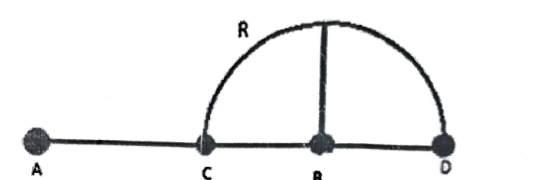
Charges +q and -q are placed at points A and B respectively, which are a distance 2L apart. C is the midpoint between A and B. What is the work done in moving a charge +Q along the semicircle CRD? (3)
Question 13:
- Define electric flux and write its SI unit. (1.5)
- Use Gauss law to obtain the expression for the electric field due to uniformly charged infinite plane sheet. (2.5)
Question 14:
A capacitor of 4 μF is charged by a battery of 12 V. The battery is disconnected and a dielectric slab of dielectric constant 8 is inserted between the plates of the capacitor to fill the space completely. Find the change in the (4)
- charge stored in the capacitor,
- potential difference between the plates of the capacitor,
- energy stored in the capacitor.
OR
Four charges +q, -q, +q and -q are to be arranged respectively at the four corners of a square ABCD of side ‘a’.
- Find the work required to put together this arrangement.
- A charge q0 is brought to the centre of the square, the four charges being held fixed. How much extra work is needed to do this?
Question 15:
- Derive an expression for the electric field intensity at a point on the equatorial line of an electric dipole of dipole moment p and length 2a. What is the direction of this field? (3)
- Draw the equipotential surfaces due to an electric dipole. (1)
- The dipole moment of a molecule is 10-30 Cm. It is placed in an electric field E of 105 V/m such that its axis is along the electric field. The direction of E is suddenly changed by 60° at an instant. Find the change in the potential energy of the dipole, at that instant. (2)
Question 16: Do the following conversions: (2)
- Benzene diazonium chloride to Phenol
- Prop-1-ene to Propan-1-ol
Question 17: Write the reactions and the conditions involved in the conversion of: (2)
- Wurtz-Fittig reaction
- Finkelstein reaction
Question 18: Give reasons: (3)
- Alkyl halides are polar but insoluble in water?
- Butan-1-ol is optically inactive but Butan-2-ol is optically active?
- Chlorine is an electron withdrawing group, yet it is ortho-, para-directing in electrophilic aromatic substitution reaction.
Question 19:
C4H9Br (A), a primary halide reacted with alcoholic KOH to give compound (B). Compound (B) when reacted with HBr gives (C), which is an isomer of (A). When (A) is reacted with sodium metal it gives compound (D), C8H18, which is different from the compound formed when n-butyl bromide is reacted with sodium. Give the structural formula of A, B, C and D and write the equation of compound (A) with sodium metal. (3)