 Class Notes NCERT Solutions for CBSE Students
| School Name: | St. Margaret Sr. Sec. School, D-Block, Prashant Vihar, Sector 14, Rohini, Delhi |
| Class: | XII |
| Subject: | Chemistry |
| Exam: | Mid Term Examination (2026–27) – Set B |
| Time: | 3 Hour |
| Maximum Marks: | 70 |
General Instructions:
Read the following instructions carefully.
- There are 33 questions in this question paper with internal choice.
- Section A consists of 16 multiple-choice questions carrying 1 mark each.
- Section B consists of 5 very short answer questions carrying 2 marks each.
- Section C consists of 7 short answer questions carrying 3 marks each.
- Section D consists of 2 case-based questions carrying 4 marks each.
- Section E consists of 3 long answer questions carrying 5 marks each.
SECTION – A
Question 01: On the basis of the information given below, mark the correct option. Information:
(A) In bromoethane and chloroethane, intermolecular interactions of A–A and B–B type are nearly the same as A–B type interactions.
(B) In ethanol and acetone mixture, A–A or B–B type intermolecular interactions are stronger than A–B type interactions.
(C) In chloroform and acetone mixture, A–A or B–B type intermolecular interactions are weaker than A–B type interactions.
(a) Solution (B) and (C) will follow Raoult’s law.
(b) Solution (A) will follow Raoult’s law.
(c) Solution (B) will show negative deviation from Raoult’s law.
(d) Solution (C) will show positive deviation from Raoult’s law.
Question 02: Which of the following alkyl halides will undergo SN1 reaction most readily?
(a) CH3CH2–I
(b) CH3CH2–F
(c) CH3CH2–Cl
(d) CH3CH2–Br
Question 03: A 1% (by mass) solution of glucose (molar mass = 180 g mol−1) is isotonic with a 1% solution (by mass) of a substance X. The molar mass of X is:
(a) 36 g mol−1
(b) 18 g mol−1
(c) 72 g mol−1
(d) 900 g mol−1
Question 04: In an electrochemical process, a salt bridge is used:
(a) as a reducing agent
(b) as an oxidizing agent
(c) to complete the internal circuit
(d) as an external circuit
Question 05: Which of the following is most stable in aqueous solution?
(a) Fe3+
(b) Cr3+
(c) Sc3+
(d) Zn2+
Question 06: KMnO4 is not acidified by HCl instead of H2SO4 because:
(a) H2SO4 is a stronger acid than HCl
(b) HCl is oxidised to Cl2 by KMnO4
(c) H2SO4 is dibasic acid
(d) rate is faster in presence of H2SO4
Question 07: Which of the following element has lowest enthalpy of atomisation?
(a) Cr
(b) V
(c) Mn
(d) Fe
Question 08: Which of the following is a vinylic halide?
(a) CH2=CH–CH2Cl
(b) CH2=CHCl
(c) C6H5Cl
(d) CH3CH2Cl
Question 09: Which of the following is a vinylic halide?
9. Which of the following is the most stable complex species?
(a) [Fe(CO)5]
(b) [Fe(CN)6]3-
(c) [Fe(C2O4)3]3-
(d) [Fe(H2O)6]3+
Question 10: Which of the following is a vinylic halide?
10. A tertiary alkyl halide would prefer to undergo:
(a) SN1 reaction
(b) SN2 reaction
(c) a-Elimination
(d) Racemisation
Question 11: Phenol reacts with CO2 at 3–7 atm, on heating in presence of NaOH followed by acidification to form:
(a) Salicylic acid
(b) Aspirin
(c) Benzoic acid
(d) Methyl benzoate
Question 12: Which of the following compound would not react with Lucas reagent at room temperature?
(a) CH2 = CH–CH2OH
(b) C6H5CH2OH
(c) CH3CH2CH2OH
(d) (CH3)3 COH
For Questions 13–16, an assertion is followed by a reason. Choose the correct answer:
(a) Assertion and reason both are correct and reason is the correct explanation of assertion.
(b) Assertion and reason both are correct statements but reason is not the correct explanation of assertion.
(c) Assertion is correct but reason is a wrong statement.
(d) Assertion is wrong but reason is a correct statement.
Question 13:
Assertion: Cu2+ iodide is not known.
Reason: Cu2+ oxidises I− to iodine.
Question 14:
Assertion: KCN reacts with methyl chloride to give methyl isocyanide.
Reason: CN– is an ambident nucleophile.
Question 15:
Assertion: Λm for weak electrolytes shows a sharp increase when the electrolytic solution is diluted.
Reason: For weak electrolytes, degree of dissociation decreases with dilution of solution.
Question 16:
Assertion: The aquatic species feel more comfortable in winter than summer.
Reason: Solubility of gases in liquid increases with increase in temperature.
SECTION – B
Question 17: In the electrolysis of aqueous sodium bromide, there are two possible anodic reactions:
2H2O(l) → O2(g) + 4H+(aq) + 4e−, E° = 1.23 V
2Cl−(aq) → Cl2(g) + 2e−, E° = 1.36 V
Which reaction occurs at the anode and why?
Question 18: Mention the reactions occurring at (i) anode and (ii) cathode during working of a Mercury cell. Why does it have a longer life time?
Question 19:
(i) Why is the C–O–C bond angle in ethers slightly greater than the tetrahedral angle?
(ii) Why does (CH3)3C–O–CH3 on reaction with HI give (CH3)3C–I and CH3OH as the main products and not (CH3)3C–OH and CH3–I?
Question 20:
If N2 gas is bubbled through water at 293 K, how many moles of N2 gas would dissolve in 1 litre of water? Assume that N2 exerts a partial pressure of 0.987 bar. Given Henry’s law constant for N2 at 293 K is 76.5 × 10³ bar.
Question 21:
Consider the three types of replacement of group X by group Y as shown in the diagram. This can result in giving compound (A) or (B) or both. What is the process called if:
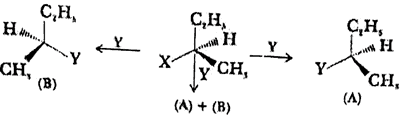
(i) (A) is the only compound obtained?
(ii) (B) is the only compound obtained?
(iii) (A) and (B) are formed in equal proportions?
SECTION – C
Question 22:
Calculate the amount of calcium chloride which must be added to 500 g of water so that the freezing point of water is depressed by 2.5 K. [Given: Kf = 1.86 K kg mol−1; atomic masses: Ca = 40.0, Cl = 35.5]
Question 23: Give reasons:
(i) p-Dichlorobenzene has lower boiling point than o- and m-isomers.
(ii) (±)-2-Butanol is optically inactive despite having a chiral carbon atom.
(iii) Haloalkanes react with KCN to form alkyl cyanides as the main product, while AgCN forms isocyanides as the chief product.
Question 24: What type of isomerism is shown by the following complexes? Write their IUPAC names:
(a) [Co(en)2Cl2]+
(b) [Co(H2O)5(NO2)]2+
(c) [Cr(NH3)3Cl3]
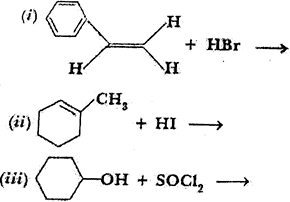
Question 25: Complete the equations for the following reactions:
Question 26: How would you account for the following?
(i) Transition metals show catalytic activities.
(ii) Transition metals form alloys.
(iii) Transition elements have high enthalpy of atomisation.
Question 27: How are the following conversions carried out? Write the reactions and conditions in each case:
(i) Phenol to salicylaldehyde
(ii) Phenol to acetophenone
(iii) Aniline to phenol
Question 28:
The resistance of a conductivity cell filled with 0.1 mol L-1 NaCl solution is 100 Ω. If the resistance of the same cell when filled with 0.02 mol L-1 KCl solution is 500 Ω, calculate the conductivity and molar conductivity of 0.1 mol L-1 NaCl solution. Conductivity of 0.02 mol L-1 KCl solution is 1.3 × 10⁻² Ω-1 cm-1.
SECTION – D
The following are case-based questions. Each question has an internal choice and carries 4 marks (1 + 1 + 2). Read the passage carefully and answer the questions that follow.
Question 29:
The lanthanoids resemble one another more closely than do the members of ordinary transition elements in any series. They have only one stable oxidation state and their chemistry provides an excellent opportunity to examine the effect of small changes in size and nuclear charge along a series of otherwise similar elements. The chemistry of the actinoids is, on the other hand, much more complicated.
Answer the following questions:
(a) Why do Zr and Hf have almost identical atomic radii?
(b) Why is Ce4+ a strong oxidising agent?
(c) Why is actinoid chemistry complicated as compared to lanthanoid chemistry? Give two reasons.
OR
(c) Write two differences between lanthanoids and actinoids.
Question 30:
The Valence Bond Theory (VBT) explains with reasonable success the formation, magnetic behaviour and geometrical shapes of coordination compounds. It, however, fails to provide a quantitative interpretation of magnetic behaviour and has nothing to say about the optical properties of these compounds. The Crystal Field Theory (CFT) of coordination compounds is based on the effect of different crystal fields (provided by the ligands taken as point charges), on the degeneracy of d orbital energies of the central metal atom/ion. The splitting of the d orbitals provides different electronic arrangements in strong and weak crystal fields. The treatment provides quantitative estimations of orbital separation energies, magnetic moments and spectral and stability parameters. However, the assumption that ligands constitute point charges creates many theoretical difficulties.
(a) Draw the geometrical isomers of complex [Pt(en)2Cl2]2+. Which of them is optically inactive?
(b) On the basis of crystal field theory, write the electronic configuration for a d4 ion, if Δo > P.
(c) Write the hybridization type and magnetic behaviour of the complex [Ni(CN)4]2-. (Atomic number of Ni = 28)
OR
(c) Why is [NiCl4]2- paramagnetic but [Ni(CO)4] diamagnetic?
SECTION – E
Question 31:
(A) Give reasons:
(i) Though both have d5 configuration, yet Cr has higher melting point than Mn.
(ii) Cr2+ is a strong reducing agent.
(B) Predict which of the following will be coloured in aqueous solution. Give reason:
Fe2+, Ti4+
(C) Write the ionic equations for the oxidising reaction of KMnO4 with:
(i) Fe2+
(ii) SO32- solution
OR
(a) When an oxide of manganese (A) is fused with KOH in the presence of an oxidising agent and dissolved in water, it gives a dark green solution of compound (B). Compound (B) disproportionates in neutral or acidic solution to give purple compound (C). An alkaline solution of compound (C) oxidises potassium iodide solution to a compound (D), and compound (A) is also formed. Identify compounds A to D and explain the reactions involved.
(b)
(i) Transition metals form a large number of complexes.
(ii) The E° value for the Mn3+/Mn2+ couple is much more positive than that for the Cr3+/Cr2+ couple.
Question 32:
(a) A solution is prepared by dissolving 10 g of non-volatile solute in 200 g of water. It has a vapour pressure of 31.84 mm Hg at 308 K. Calculate the molar mass of the solute. (Vapour pressure of pure water at 308 K = 32 mm Hg.)
(b) Define azeotropes. What type of azeotrope is formed by positive deviation from Raoult’s law? Give an example.
OR
(a) Phenol associates in benzene to a certain extent to form a dimer. A solution containing 20 g of phenol in 1.0 kg of benzene has its freezing point lowered by 0.69 K. Calculate the fraction of phenol that has dimerised.
[Given Kf for benzene = 5.1 K m−1]
(b) Define reverse osmosis. Write one application.
Question 33:
(a) Define the following terms:
(i) Limiting molar conductivity
(ii) Fuel cell
(b) Calculate the emf of the following cell at 25 °C:
Fe | Fe2+ (0.001 M) || H+ (0.01 M) | H2(g) (1 bar) | Pt(s)
E°(Fe2+/Fe) = −0.44 V
OR
(a) State Faraday’s first law of electrolysis. How much charge, in terms of Faraday, is required for the reduction of
1 mol of MnO4− to Mn2+?
(b) Calculate the emf of the following cell at 298 K:
Al(s) | Al3+ (0.1 M) || Cu2+ (0.01 M) | Cu(s)
Given: E°cell = 2.00 V (log 10 = 1)