 Class Notes NCERT Solutions for CBSE Students
| School Name: | St. Margaret Sr. Sec. School, D-Block, Prashant Vihar, Sector 14, Rohini, Delhi |
| Class: | XII |
| Subject: | Chemistry |
| Exam: | Periodic Test I (2026–27) – Set B |
| Time: | 1 Hour |
| Maximum Marks: | 30 |
General Instructions:
Read the following instructions carefully
- There are 19 questions in this question paper.
- Q No-1 to 10 are MCQ carrying 1 mark each.
- Q No-11 to 17 are short answer questions carrying 2 marks each.
- Q No-18 to 19 are long answer questions carrying 3 marks each.
- All questions are compulsory.
Question 01: The IUPAC name of (CH3)3C-OH is: (1)
- 1-Methyl-1-propanol
- 2-Methyl-1-propanol
- 2-Methyl-2-propanol
- Isobutyl alcohol
Question 02: CH3CH2OH can be converted into CH3CHO by ____________________. (1)
- catalytic hydrogenation
- treatment with LiAlH4
- treatment with pyridinium chlorochromate
- treatment with KMnO4
Question 03: Phenol reacts with CO2 at 3-7 atm, on heating in presence of NaOH followed by acidification to form (1)
- Salicylic acid
- Aspirin
- Benzoic acid
- Methyl benzoate
Question 04: Which of the following is hydrolysed most easily? (1)
- CH3I
- CH3Br
- CH3Cl
- CH3F
Question 05: Which is the correct increasing order of boiling points of the following compounds?
1-Bromoethane, 1-Bromopropane, 1-Bromobutane, Bromobenzene (1)
- Bromobenzene < 1-Bromobutane < 1-Bromopropane < 1-Bromoethane
- Bromobenzene < 1-Bromoethane < 1-Bromopropane < 1-Bromobutane
- 1-Bromopropane < 1-Bromobutane < 1-Bromoethane < Bromobenzene
- 1-Bromoethane < 1-Bromopropane < 1-Bromobutane < Bromobenzene
Question 06: Which of the following is a vinylic halide? (1)
- CH2=CH-CH2Cl
- CH3CH=CH-Cl
- C6H5Cl
- CH3CH2Cl
Question 07: Among the following sets of reactants which one produces ethanol? (1)
- HCHO; CH3MgX, H2O
- C6H5OH; NaOH, CH3I
- C6H5OH, neutral FeCl3
- C6H5-CH3; CH3COCl; AlCl3
Question 08: Arrange the following in increasing order of acidic character: (1)
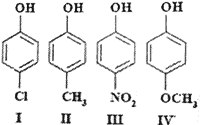
- IV < III < I < II
- II < IV < I < III
- I < II < III < IV
- III < I < II < IV
Question 09: In the following questions a statement of assertion followed by a statement of reason is given. Choose the correct answer out of the following choices.
- Assertion and reason both are correct and reason is correct explanation of assertion.
- Assertion and reason both are correct statements but reason is not correct explanation of assertion.
- Assertion is correct but reason is wrong statement.
- Assertion is wrong but reason is correct statement.
Assertion: KCN reacts with methyl chloride to give methyl isocyanide.
Reason: CN– is an ambident nucleophile. (1)
Question 10: Assertion: Phenol undergo nucleophilic substitution easily. (1)
Reason: The -OH group in phenol is stabilized by resonance.
Question 11: Give mechanism of the following reaction: (2)
CH2=CH2 + H2O
H+ →
CH3CH2OH
Question 12: (2)
(a) Which alkyl halide from the following pairs would you expect to be CHIRAL and why?
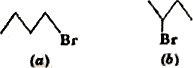
(b) Out of SN1 and SN2, which reaction occurs with racemisation? Give reason.
Question 13: (2)
- Phenol is more acidic than ethanol. Give reason for your answer.
- Why C-O-H bond angle in alcohol is slightly smaller than tetrahedral angle?
Question 14: Write chemical equation when (2)
- methyl chloride is treated with AgNO2.
- bromobenzene is treated with CH3Cl in the presence of anhydrous AlCl3.
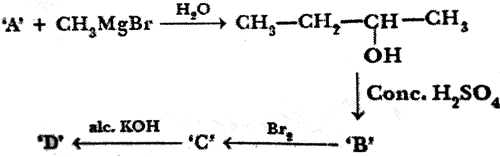
Question 15: Write the structural formulae of the organic compounds ‘A’, ‘B’, ‘C’ and ‘D’ in the following sequence of reactions: (2)