 Class Notes NCERT Solutions for CBSE Students

ST MARGARET SR SEC. SCHOOL
PRE-FINAL EXAMINATION 2025–26
| Subject: | PHYSICS |
| Class: | XI |
| Time: | 3 Hours |
| Maximum Marks: | 70 |
General Instructions:
- All questions are compulsory.
- This question paper has five sections: Section A, Section B, Section C, Section D, and Section E.
- All sections are compulsory.
- Use of calculators is not allowed.
SECTION – A (1×16)
Question 01. Two wires of copper having the lengths in the ratio 4 : 1 and their radii ratio as 1 : 4 are stretched by the same force. The ratio of longitudinal strain in the two wires will be
- 1 : 16
- 16 : 1
- 1 : 64
- 64 : 1
Question 02. An ideal fluid flows through a pipe of non-uniform diameter. The maximum and minimum diameters of the pipe are 6.4 cm and 4.8 cm respectively. The ratio of minimum and maximum velocities of fluid in this pipe is
- 9 : 16
- 3 : 4
- 4 : 3
- 16 : 9
Question 03. A steel ball is dropped in oil, then
- the ball attains constant velocity after some time
- the ball stops
- the speed keeps increasing
- none of these
Q4. 50 g of ice at 0°C is mixed with 50 g of water at 80°C. The final temperature of the mixture is
- (a) 0°C
- (b) 40°C
- (c) 60°C
- (d) 4°C
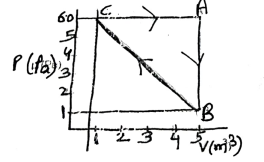
Q5. For the given cyclic process shown for a gas, the work done is
- (a) 30 J
- (b) 10 J
- (c) 5 J
- (d) 1 J
Q6. A particle executing SHM has amplitude 0.01 m and frequency 60 Hz. The maximum acceleration of the particle is
- (a) 144π² m/s²
- (b) 144 m/s²
- (c) 288π² m/s²
- (d) 144/π² m/s²
Q7. State the number of significant figures in the following:
(i) 0.007 m² (ii) 2.64 × 10²⁴ kg (iii) 0.2370 g/cm³ (iv) 6.032 N/m²
Q8. The square of resultant of two equal forces is three times their product. The angle between the forces is
- (a) π
- (b) π/2
- (c) π/4
- (d) π/3
Q9. No force is required for
- (a) motion with constant velocity
- (b) circular motion
- (c) motion with constant acceleration
- (d) elliptical motion
Q10. A 30 g bullet travelling initially at 500 m/s penetrates 12 cm into a wooden block. The average force exerted is
- (a) 31250 N
- (b) 41250 N
- (c) 31750 N
- (d) 3040 N
Q11. Which is a vector quantity?
- (a) Angular momentum
- (b) Work
- (c) Potential energy
- (d) Electric current
Q12. Energy required to move a body of mass m from orbit radius 2R to 3R is
- (a) GMm/12R²
- (b) GMm/3R
- (c) GMm/8R
- (d) GMm/6R
Q13. Assertion: Impulsive force is large and acts for a short time.
Reason: Finite change in momentum is produced by the force.
Q14. Assertion: Mass and energy are conserved together.
Reason: One can be obtained at the cost of the other.
Q15. Assertion: If polar ice melts, days will be longer.
Reason: Moment of inertia decreases and angular velocity increases.
Q16. Assertion: Time period of a pendulum on a satellite orbiting Earth is infinite.
Reason: Time period is inversely proportional to √g.
SECTION – B (2×5)
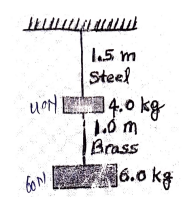
Q17. Two wires of diameter 0.25 cm, one of steel and the other of brass, are loaded as shown. Calculate the elongations of the steel and brass wires.
Q18. Calculate the heat required to convert 3 kg of ice at −12°C into steam at 100°C.
Q19. A ball is released from the top of a tower of height h metre. It takes T seconds to reach the ground. Find its position at T/3 second.
Q20. The diagonals of a parallelogram are represented by vectors r₁ = 3i + 2j − 7k and r₂ = 5i + 6j − 3k. Find its area.
Q21. If angular momentum is conserved but moment of inertia decreases, will rotational kinetic energy be conserved?
SECTION – C (3×7)
Q22. 1 g of water at 100°C is converted into steam at the same temperature. Find the change in internal energy.
Q23. (a) At what temperature is rms velocity of hydrogen seven times that of nitrogen at 300 K?
(b) Find Cp/Cv for a mixture of helium and oxygen.
Q24. Derive an expression for volume of liquid flowing per second through a narrow pipe using dimensional analysis.
Q25. For a body projected upward with velocity v₀, draw acceleration-time, velocity-time and position-time graphs.
Q26. A ball is kicked at 30° with the vertical. If horizontal velocity is 19.6 m/s, find maximum height and range.
Q27. Three masses 3 kg, 4 kg and 5 kg are located at the corners of an equilateral triangle of side 1 m. Find the centre of mass.
SECTION – D (4×2)
Q28. (a) Calculate escape speed from Earth.
(b) At what height above Earth is g same as in a mine 80 km deep?
Q29. A simple pendulum oscillates with small amplitude. Answer the following:

- (i) Graph of time period vs length
- (ii) Condition for SHM
- (iii) Effect of increasing length
- (iv) Time period on satellite