 Class Notes NCERT Solutions for CBSE Students

11th Class CBSE Board Physics PT-01 SET B Examination (2025-26): St. Margaret Sr. Sec. School, Prashant Vihar, Sector 14, Rohini, Delhi-85 India
| School Name: | St. Margaret Sr. Sec. School, D-BLOCK, Prashant Vihar, Sector 14, Rohini, New Delhi 110085 India |
| Subject: | Physics |
| Class: | XI |
| Time: | 3 Hours |
| Maximum Marks: | 70 |
General Instructions:
- There are 33 questions in all. All questions are compulsory.
- This question paper has five sections: Section A, Section B, Section C, Section D and Section E.
- All the sections are compulsory.
- Section A contains sixteen questions: twelve MCQs and four assertion-reasoning-based questions of 1 mark each. Section B contains five questions of two marks each. Section C contains seven questions of three marks each. Section D contains two case-study-based questions of four marks each and Section E contains three long-answer questions of five marks each.
- There is no overall choice. However, an internal choice has been provided in one question in Section B, one question in Section C, one question in CBQ in Section D and all three questions in Section E. You have to attempt only one of the choices in such questions.
- Use of calculators is not allowed.
SECTION – A (1×16)
Question 01. The number of significant digits in 0.400 is
- (a) 1
- (b) 2
- (c) 3
- (d) 4
Question 02. The equation of state of a real gas is given by (P + a/V²) (V − b) = RT. What is the dimension of constant a?
- (a) MLT⁻¹
- (b) ML⁵T⁻²
- (c) M²L⁵T⁻¹
- (d) ML⁵T⁻²
Question 03. The dimensions of impulse are equal to that of
- (a) pressure
- (b) force
- (c) linear momentum
- (d) angular momentum
Question 04.The variation of quantity A with quantity B plotted in the figure describes the motion of a particle in a straight line.
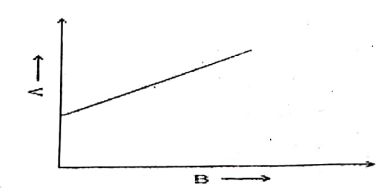
- (a) Quantity A is displacement if motion is uniform.
- (b) Quantity A is distance if motion is uniformly accelerated.
- (c) Quantity A is velocity if motion is uniform.
- (d) None of the above.
Question 05. If the displacement of an object is proportional to square of time, then the object is moving with
- (a) constant acceleration
- (b) uniform motion
- (c) constant velocity
- (d) non-uniform motion
Question 06. What is the angle between centripetal acceleration and tangential acceleration?
- (a) 180°
- (b) 0°
- (c) 90°
- (d) 45°
Question 07. The minimum number of vectors having different planes which can be added to give zero resultant is
- (a) 2
- (b) 3
- (c) 4
- (d) 5
Question 08. A stone is projected at an angle of 30° to the horizontal. The ratio of kinetic energy of the stone at point of projection to its kinetic energy at the highest point of flight will be
- (a) 4 : 1
- (b) 1 : 2
- (c) 4 : 3
- (d) 1 : 4
Question 09. A jet engine works on the principle of conservation of
- (a) linear momentum
- (b) angular momentum
- (c) energy
- (d) mass
Question 10. A balloon has 5 g of air. A small hole is pierced into it. The air escapes at a uniform rate with a velocity of 4 cm/s. If the balloon shrinks completely in 2.5 s, then the average force acting on the balloon is
- (a) 2 dyne
- (b) 2N
- (c) 8 dyne
- (d) 8N
Question 11. If a pendulum bob on a 2 m string is displaced 60° from the vertical and then released, what is the speed of the bob as it passes through the lowest point in its path?
- (a) √2 × 9.8 m/s
- (b) √2 m/s
- (c) 4.43 m/s
- (d) 1/√2 m/s
Question 12. A man weighing 50 kgf carries a load of 10 kgf to the top of the building in 5 minutes. The work done by him will be
- (a) 10⁵ J
- (b) 5 × 10⁵ J
- (c) 2.5 × 10⁵ J
- (d) 12 × 10⁵ J
Question 13.
Assertion (A): Energy cannot be divided by volume.
Reason (R): Dimensions of energy and volume are different.
- (a) Both A and R are true and R is the correct explanation of A
- (b) Both A and R are true but R is not the correct explanation of A
- (c) A is true but R is false
- (d) A is false but R is true
Question 14.
Assertion (A): The position-time graph of a uniform motion in one dimension of a body can have a negative slope.
Reason (R): In one-dimensional motion the position does reverse, so it can have a negative slope.
Question 15.
Assertion: The maximum horizontal range of a projectile is proportional to the square of velocity.
Reason: The maximum horizontal range of a projectile is equal to the maximum height attained by the projectile.
Question 16.
Assertion: A quick collision between two bodies is more violent than a slow collision even when the initial and final velocities are identical.
Reason: The momentum is larger in the first case.
SECTION – B (2×5)
Question 17. If m, M, R and r denote the mass of the satellite, the mass of the planet, the radius of the planet and the radius of the orbit of the satellite, respectively, determine the dimensions of (2πR / g √(r³)), where g is the acceleration due to gravity.
OR
Q17. Distinguish between dimensional and non-dimensional constants.
Question 18. A ball A is thrown vertically upwards with a speed of 25 m/s from the ground. Another ball, B, is thrown vertically downward from a height of 50 m with the same speed and along the line of motion of ball A. At what point do the two balls collide? Take g = 9.8 m/s².
Question 19. What are the horizontal and vertical components of acceleration of a body thrown horizontally with uniform speed?
Question 20. A bullet is dropped from a certain height and at the same time another bullet is fired horizontally from the same height. Which one will hit the ground earlier and why?
Question 21. A ball moving with a momentum of 5 kg m s⁻¹ strikes against a wall at an angle of 45° and is reflected at the same angle. Calculate the impulse.
SECTION – C (3×7)
Question 22. The length, breadth and height of a block are 16.2 cm, 8.2 cm and 2.40 cm. Calculate its volume in appropriate significant figures.
Question 23. A jet of water of cross-sectional area A impinges normally on a stationary flat plate with velocity V. If ρ is the density of water, determine by dimensional analysis the expression for the force F exerted by the jet on the plate.
Question 24. A particle is moving along a straight line and its position is given by x = (t³ − 6t² − 15t + 40) m. Find
- the time at which velocity is zero,
- position and displacement of the particle at that point,
- acceleration of the particle at the time.
Question 25. State and prove the parallelogram law of vector addition.
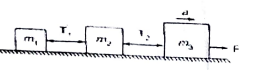
Question 26. As shown in the figure, three blocks connected together lie on a horizontal frictionless table and are pulled to the right with a force F = 50 N. If m₁ = 5 kg, m₂ = 10 kg and m₃ = 15 kg, find the tensions T₁ and T₂.
Question 27.
Deduce that the angle of repose is equal to the angle of friction.
OR
- Why is it necessary to bend knees while jumping from a greater height?
- In a tug of war, a team that pushes harder against the ground wins. Why?
- A cricket player lowers his hands to catch the ball safely. Why?
Question 28. If the kinetic energy of a body increases by 300%, what is the percentage increase in linear momentum of the body?
SECTION – D (4×2)
Question 29. A body is said to be a projectile if it is projected into space with some initial velocity and then it continues to move in a vertical plane such that its horizontal acceleration is zero and vertical downward acceleration is equal to g…
(full case-based paragraph retained)
Question 29. – I. Which of the following is true regarding projectile motion?
- (a) Horizontal velocity is constant
- (b) Vertical velocity is constant
- (c) Acceleration is not constant
- (d) Momentum is constant
Question 29. – II. At the top of the trajectory of a projectile thrown at angle < 90°, its
- (a) velocity is zero
- (b) velocity is parallel to acceleration
- (c) velocity is anti-parallel to acceleration
- (d) velocity is perpendicular to acceleration
Question 29. – III. Three particles A, B and C are projected from the same point with same initial speed making angles 30°, 45° and 60°, respectively… Which statement is correct?
Question 29. – IV. A particle is projected at 45°. The relation between range and maximum height attained is
- (a) R = 4H
- (b) 4R = H
- (c) 2H = R
- (d) none of these
Question 30. There are many types of springs… (full case paragraph preserved.)
Answer the following:
(i)–(iv) sub-parts retained exactly.
SECTION – E (5×3)
Question 31.
A person of mass ‘m’ is standing in a lift. Find his apparent weight when lift is
- moving upward with uniform acceleration ‘a’
- moving downward with uniform acceleration ‘a’ (a < g)
- falls freely.
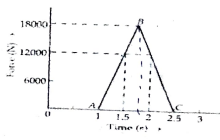
(ii). The figure shows an estimated force-time graph for a baseball struck by a bat. From this curve determine
- impulse delivered to the ball
- force exerted on the ball.
OR
Derive an expression for the maximum speed of a car moving on a banked circular road having a coefficient of friction μ with an appropriate diagram.
Question 32.
Graphically derive the equations of motion.
OR