 Class Notes NCERT Solutions for CBSE Students
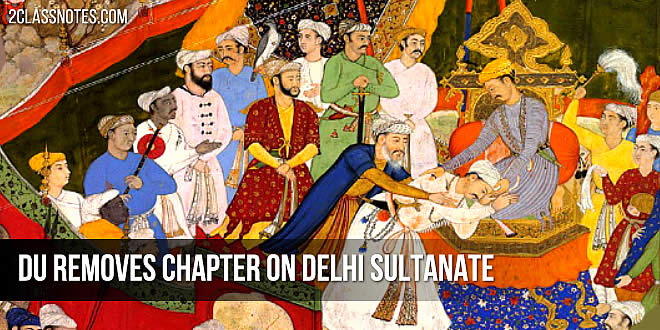
Delhi University removes chapter on the Delhi Sultanate, the invaders who destroyed Hindu temples, from PG syllabus
The University of Delhi has revised the History postgraduate syllabus by dropping a paper on the Delhi Sultanate from the list of Discipline Specific Elective (DSE) papers. The paper titled “The Delhi Sultanate: Structures of Authority in Medieval North India (13th-14th Centuries)” was being taught in Semester III of the postgraduate degree.
Delhi University drops Delhi Sultanate from postgraduate syllabus
The varsity notified the modified syllabus in a notification dated August 7, 2026. Along with the paper on the Delhi Sultanate, several other long-running courses on medieval, ancient and modern India have also been dropped. Other papers to be omitted from the third semester include papers on “History of North India, c. 1400-1550”, “Gender and Women in Early India: 1500 BCE to 1000 CE”, “Political Processes and Structure of Polities in Ancient Indian Literature”.
The papers “The Delhi Sultanate: Structures of Authority in Medieval North India (13th-14th Centuries)” and “History of North India, c. 1400-1550” were part of the old syllabus for the 2019-20 academic year and had been taught in the department for several years.
Records reportedly show that, of the 38 DSE papers proposed by DU’s History Department, 16 were included in the Semester III syllabus. A DSE is an elective course, which allows a postgraduate History student to select a specialised area to study along with mandatory papers.
The decision to modify the syllabus involves several stages. The proposed course is first cleared through the department’s Committee of Courses. The proposal then goes to the Standing Committee of the university and then to the Academic Council. After being approved by the Academic Council, the syllabus goes to the Executive Council for final approval.
The Delhi Sultanate period:
The Delhi Sultanate was established through military conquest and was marked by widespread plunder and destruction of Hindu temples. Ample historical records capture the brutality of the period, describing the killing of soldiers as well as civilians, including women and children.
The military conquests carried out by the Islamic invaders during the period were accompanied by massacres, enslavement, forced displacement, plunder, and harsh punishments. Thousands of temples were attacked, destroyed and looted by the Islamic invaders, including prominent temples such as the Somnath Temple in Gujarat, the Kashi Vishwanath Temple in Varanasi, the Vaishnavite sites in Srirangam and several temples in the Deccan and South India.